
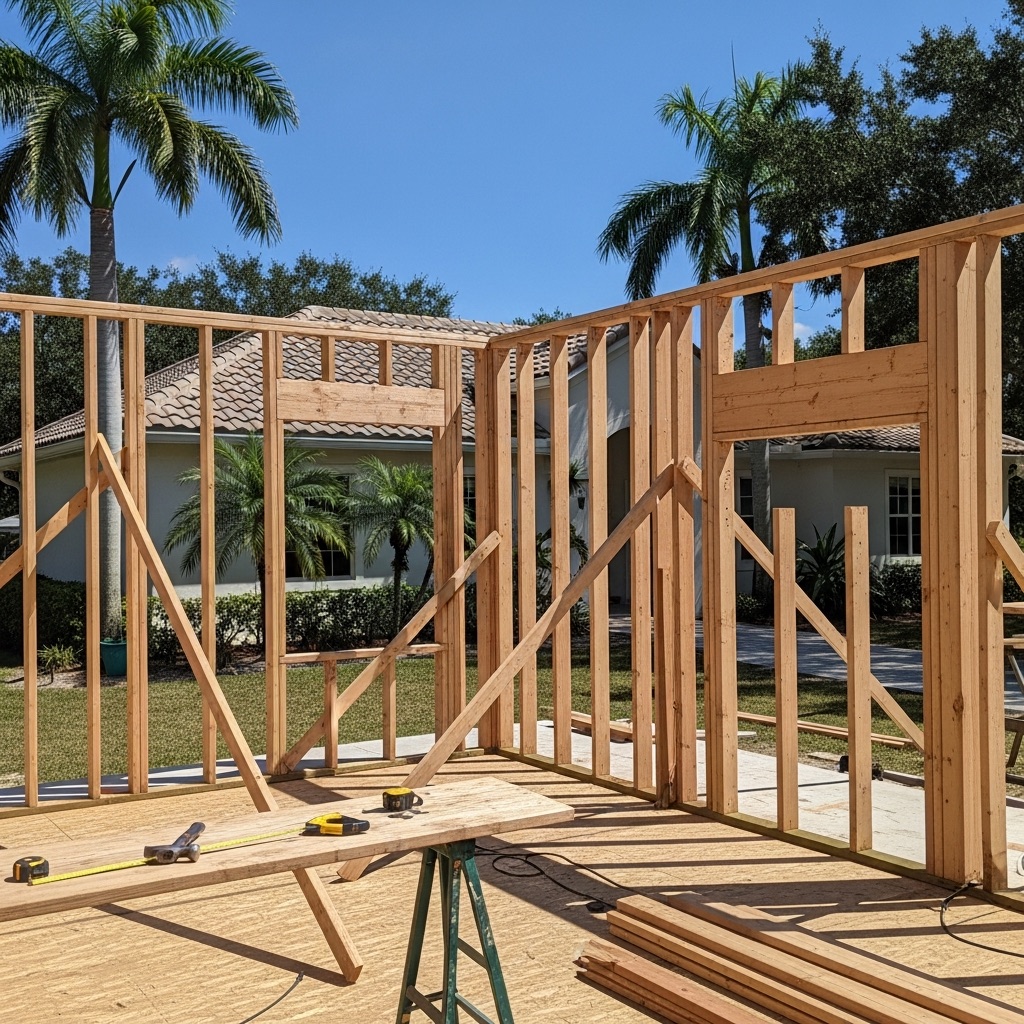
If you are planning work on a house in a St. Augustine flood zone, the rule that decides the shape of the project is usually not the one people expect. It is the 50 percent rule. Both St. Johns County and the City of St. Augustine count repairs, additions and improvements cumulatively over a five year window, and once that running total reaches 50 percent of the structure's market value before the work started, the entire building has to be brought up to current floodplain standards. Not the room you are remodeling. The building.
That threshold is what turns a kitchen and two baths into an elevation project, and it is why the flood question has to be answered before the scope is set rather than after a designer has drawn something.
The 50 percent rule and the five year clock
St. Johns County's flood damage prevention ordinance defines a substantial improvement as any combination of repair, reconstruction, rehabilitation, addition or improvement of a building taking place during a five year period, the cumulative cost of which equals or exceeds 50 percent of the market value of the structure before the improvement or repair is started. For each building, that five year period begins on the date of the first improvement or repair made after January 1, 2009.
The City of St. Augustine applies the same structure: any repair, reconstruction, rehabilitation, addition or other improvement over a five year period where the total cost reaches 50 percent of the building's market value before construction begins. The city's building code then requires that substantial improvement to meet the same standards as a new building in the floodplain.
Three details cause most of the trouble when a homeowner works this out alone.
Market value means the structure, not the property. Land is excluded. On a lot in the Old City, on Anastasia Island, or anywhere the dirt carries most of the price, the building's value can be well below what the tax bill or a Zillow estimate implies, which makes 50 percent much easier to reach than people assume.
It is cumulative. The bathroom you did three years ago counts against the kitchen you want to do now. So does the roof, if it fell inside the window.
Substantial damage collapses the whole thing. If the building has sustained substantial damage, the repairs are treated as substantial improvement regardless of what the repair work actually consists of.
What "elevated enough" means here
St. Johns County is a Community Rating System participant and adopted higher standards than the federal minimum to earn that status. One of them is one foot of freeboard in all special flood hazard areas, so the design flood elevation is base flood elevation plus a foot rather than base flood elevation on the nose. The ordinance also carries compensatory fill requirements and restricts residential construction within floodways.
Zone AO works differently and catches people out. There, the design flood elevation is the highest existing grade around the building's perimeter plus the depth number printed on the flood map plus one foot of freeboard. Where the map shows no depth number, the depth is taken as two feet, which puts the design elevation three feet above grade.
The zone letter on your map panel tells you which set of rules applies:
- A is a special flood hazard area with no published base flood elevation, which usually means someone has to develop one.
- AE is the common one, a mapped one percent annual chance flood with a published base flood elevation.
- AH is shallow ponding, typically one to three feet, with a published elevation.
- AO is sheet flow with a depth number instead of an elevation.
- VE is coastal high hazard, where waves of three feet or more are expected.
The jump from AE to VE changes the building, not just the height. In a V zone the structure goes on an open foundation of piles or columns, the bottom of the lowest horizontal structural member has to sit at or above the design flood elevation, anything enclosed below has to be breakaway construction, and fill cannot be used for structural support. In an A zone the lowest floor has to be at or above the design flood elevation, and there is more freedom in how you get it there.
Get the elevation certificate before you get excited
An elevation certificate is the document that settles where a building actually sits relative to base flood elevation. It is also the document that determines what you pay for flood insurance. The City of St. Augustine's Planning and Building Department can provide certificates on file for properties from 1992 to the present, and St. Johns County's floodplain team reviews and maintains them for the unincorporated county. If no certificate exists for the property, a surveyor produces one.
Two things worth knowing on the insurance side. St. Johns County holds a CRS Class 5 rating, which provides a 25 percent discount on National Flood Insurance Program policies written in the county on or after April 1, 2023. And an elevation certificate that shows a favorable number is worth ordering even when nobody has asked for one, because it is the evidence the rating uses.
Which desk you are standing at changes the answer
Wilson & Co serves homeowners in St. Augustine, Jacksonville, Ponte Vedra, Nocatee, Palm Coast and the Flagler area, and the floodplain rules are not uniform across that footprint. A house inside the City of St. Augustine limits is reviewed by the city. A house on a county road two miles away is reviewed by St. Johns County. Duval County properties run through the City of Jacksonville, which is a different conversation again for older neighborhoods. The 50 percent rule exists in all of them because it is federal, but the freeboard, the cumulative window and the review process are local.
Confirm the parcel with the reviewing authority rather than with a neighbor. Two houses on the same street can sit in different zones, and a map revision can move a property in or out. Local floodplain standards also get amended, so check the current requirement with the jurisdiction rather than working from an older version of the rule.
The order that saves money
The sequence that works on flood zone projects is boring and it is the whole game.
- Establish the flood zone and base flood elevation for the parcel.
- Get or order the elevation certificate.
- Get a defensible market value for the structure alone.
- Add up any permitted work in the last five years.
- Then set the scope, knowing where the 50 percent line falls.
Doing it in that order lets you make a real decision. Some homeowners deliberately stay under the threshold and phase the work. Others look at the number, decide the house is worth raising, and build the project around that. Both are reasonable. What is not reasonable is finding out at plan review, after the drawings are done and the cabinets are ordered.
If the work involves an addition or a master suite, the flood question also drives the foundation and the floor transition between old and new, which is the single most expensive detail to change late. For whole home renovations on older coastal stock, it usually determines whether the project is a remodel or a rebuild.
Wilson & Co Design Build handles design and construction as one process, which matters on flood zone work specifically because the elevation answer changes the drawings, the foundation, the systems and the budget at the same time. Bring the property address and the elevation certificate if you have one. If you do not, that is the first thing to go and find.
For the rest of what plan review will look at once the flood question is settled, see what actually needs a permit in St. Johns County. For the openings themselves, hurricane and product approval requirements run alongside the floodplain rules and are checked separately.
Call (904) 792-6175 or use the project form to share what you want to change.
Related service
Home Additions & Master Suite Cost Planning
Add the room your home is missing while keeping the neighborhood, lot, and daily routines that already work.
View Service