
In This Article
Adding space to your home is one of the biggest investments you'll make as a homeowner in Northeast Florida. Whether you're expanding a master suite, adding a room for a growing family, or building out an in-law suite, the process involves a lot more than just hammering boards together. Understanding each phase — from the first shovel in the ground to the finished exterior — helps you stay informed, set realistic expectations, and avoid surprises.
Here's a detailed look at what actually happens during a home addition in St. Augustine, based on the way our team at Wilson & Co Design Build approaches every project.
Phase 1: Design, Permits, and Pre-Construction Planning
Before any construction begins on your home addition in St. Augustine, your design-build contractor handles a critical planning phase. As a design-build firm, we complete both the design and the construction under one roof — which means faster communication, fewer handoffs, and a smoother overall process.
What happens during pre-construction:
- • Architectural drawings and structural engineering plans
- • Permit application to St. Johns County Building Department
- • Site survey and soil assessment if required
- • Selection of exterior finishes, windows, and materials
- • Construction timeline and milestone schedule
Phase 2: Foundation — Concrete Block and Floor Framing
Once permits are in hand, the first crew on site handles the foundation. For most home additions in Northeast Florida, this means a concrete masonry unit (CMU) block foundation — commonly called a concrete block foundation. CMU is the standard choice here for good reason: it holds up well in Florida's humidity, resists termites, and provides the structural rigidity required under state building codes.
The foundation sequence:
1. Excavation and footings — The crew digs down to stable soil and pours concrete footings. Footing depth depends on soil conditions and the load the addition will carry. 2. Block wall construction — CMU blocks are laid and filled with rebar and concrete grout for reinforcement. 3. Floor system — Pressure-treated floor joists span the foundation, providing the structural deck for the floor above. Joist sizing is engineered for the specific span and load. 4. Inspection — A St. Johns County inspector signs off on the foundation before framing begins. Nothing moves forward without this.
This phase looks deceptively simple from the street, but it's the most critical part of the project. A properly built foundation means no settling, no cracking, and no structural headaches 10 years from now.
Phase 3: Wall Framing and Hurricane Straps
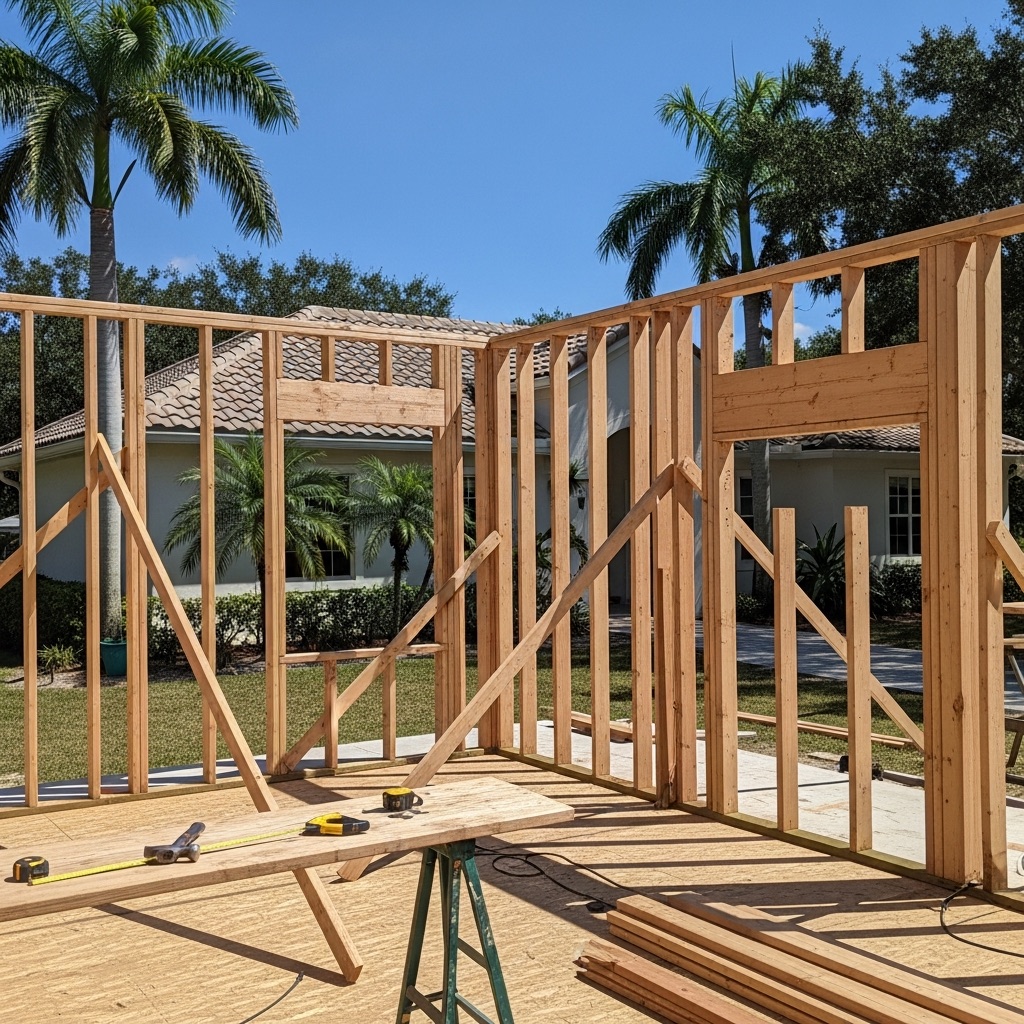
With the foundation approved, the framing crew gets to work. This is the phase where your addition starts to look like an actual structure. In Florida, framing is not just about putting up walls — it has to meet Florida's strict wind-load requirements, including mandatory hurricane strap installation.
What framing involves:
- • Wall framing — Exterior and interior walls are framed with dimensional lumber according to engineered plans. Wall spacing, header sizes, and structural openings are all specified.
- • Hurricane straps — Every rafter and roof truss is mechanically connected to the wall framing with galvanized hurricane straps. These metal connectors are required by Florida building code and are what keep roofs attached to walls during high-wind events. This is non-negotiable in St. Augustine and all of Northeast Florida.
- • Window and door rough openings — Framed precisely to spec so windows and doors install cleanly without shimming or modification.
- • Framing inspection — Another county inspection before the walls are closed in.
Phase 4: Roof Sheathing and Weatherproofing
Once the walls are framed and inspected, roof trusses or rafters are set and roof sheathing goes on. For a second-story or full room addition, this phase makes the structure weather-tight so interior work can begin regardless of rain.
The roof sequence:
- • Roof trusses engineered and delivered to site
- • Trusses set and anchored with hurricane straps (same principle as the wall-to-plate connections)
- • OSB roof sheathing applied — typically 7/16" or 5/8" depending on truss spacing and local wind zone requirements
- • Peel-and-stick ice-and-water shield at eaves and valleys
- • Synthetic roofing underlayment over the full deck
- • Shingles or standing-seam metal roofing installed to match or complement the existing home
Phase 5: Exterior Finishes — Siding and Stone Veneer Accents
With the structure weatherproofed, exterior finish work begins. This is the phase that determines how your addition blends with your existing home — or makes a deliberate design statement. For the addition shown in our gallery, we combined fiber cement lap siding with stone veneer accents for a finished look that adds curb appeal and visual weight to the base of the structure.
What this phase includes:
- • Housewrap installation — A moisture barrier over the sheathing before any cladding goes on
- • Fiber cement siding — Durable, low-maintenance, and paintable. Holds up exceptionally well in Florida's heat and humidity compared to wood or vinyl.
- • Stone veneer — Manufactured stone panels applied to accent areas (typically the base, corners, or gable sections). Provides the look of real stone at a fraction of the weight and cost.
- • Trim, fascia, and soffit — Wrapped in PVC or aluminum to eliminate rot and maintenance
- • Paint or finish coat — Matched to the existing home's color scheme for a seamless addition, or a coordinated new palette
Phase 6: Interior Rough-Ins and Finishing
Once the exterior is complete and weathertight, the interior trades move in: rough electrical, plumbing (if applicable), and HVAC ductwork are run before insulation and drywall close the walls. Then:
- • Insulation (blown-in or batt, depending on wall configuration)
- • Drywall hang, tape, and finish
- • Interior trim, doors, and built-ins
- • Flooring
- • Paint
- • Fixtures and final connections
How Long Does a Home Addition Take?
For a standard room addition or master suite addition in St. Augustine, expect:
- • Design and permitting: 6–10 weeks
- • Foundation through framing: 3–5 weeks
- • Exterior and interior finishes: 6–12 weeks depending on scope
FAQ
Do I need a permit for a home addition in St. Augustine? Yes. All home additions in St. Johns County require a building permit. This covers structural, electrical, plumbing, and HVAC work. We handle the full permitting process as part of our design-build service.
What foundation type is used for home additions in Northeast Florida? Concrete masonry unit (CMU) block foundations are standard in this area. They perform well in Florida's soil conditions, provide excellent structural support, and meet all local code requirements.
Are hurricane straps required in St. Augustine? Yes. Florida building code requires hurricane straps connecting roof trusses and rafters to wall framing throughout the state. This is inspected and verified before construction continues.
Can I match my existing exterior during an addition? Yes — matching existing siding, roofline, trim, and paint is standard practice. We also work with homeowners who want to use the addition as an opportunity to refresh or upgrade the whole home's exterior look.
What is a design-build contractor and why does it matter for a home addition? A design-build contractor handles both the architectural design and construction under one contract. This eliminates the gap between what was designed and what gets built — and keeps the project on schedule with one point of accountability.
---
Ready to Add Space to Your St. Augustine Home?
Wilson & Co Design Build specializes in home additions throughout St. Augustine, Ponte Vedra, Jacksonville, and Northeast Florida. We manage every phase — design, permitting, foundation, framing, and finishing — so you don't have to coordinate between multiple contractors.
Schedule your free consultation today and let's talk through what's possible for your home.
Ready to Start Your Project?
Contact Wilson & Co Design Build for a free consultation on your remodeling project.
